Best AI tools for R&D tax credit research and documentation
Every year the R&D study lands on your desk, and the same question follows it. Will this substantiation hold up if a reviewer, a partner, or the IRS pushes back? Get it wrong and you are looking at a disallowed credit and hours spent defending work that should have been solid the first time.
The best AI tool for this work depends on the job. Data-capture and estimation tools pull and quantify qualified research expenses (QREs) from payroll, engineering systems, and your ERP. Primary-authority research tools answer the legal questions behind the claim: does this activity satisfy section 41(d), how are the costs treated under section 174A, and what does the revised Form 6765 now require? A third, less obvious job sits ahead of both: confirming a client is actually eligible for R&D credits, and other incentives, before anyone runs a study at all.
This article splits the field into those jobs and evaluates eight tools honestly on each. You will see which tools estimate the credit, which defend the positions behind it, which one finds the opportunity in the first place, and where each falls short.
Key takeaways
- The tool field splits into three jobs, not two. Data-capture tools estimate the credit from your systems; primary-authority research tools ground and defend the legal positions behind it; discovery tools confirm eligibility before a study starts. Most firms need at least two of the three.
- Form 6765 raised the documentation bar. Section G business-component reporting is optional for tax years 2024 and 2025 and required for tax year 2026, so contemporaneous substantiation matters more than ever.
- Section 174A changed the economics for 2025 forward. Immediate expensing of domestic research costs is back under section 174A; a retroactive election was available to eligible small businesses (average annual gross receipts of $31 million or less), but that window closed no later than July 6, 2026, and for many taxpayers it closed earlier under the applicable section 6511 refund-claim deadline.
- No AI tool produces audit-defensible documentation on its own. Every serious option, including Bizora, is a supplemental tool that amplifies professional judgment, not a shortcut around review.
- Bizora sits on the research side, not the estimation or discovery side. It does not scrape your engineering systems to self-estimate a credit; it answers the authority questions with source-cited output and a View Steps trail built for partner review.
How the tools compare at a glance
| Tool | Primary job | Authority grounding | Documentation output | Best for |
|---|---|---|---|---|
| Neo.Tax | Data capture and credit estimation | Limited; workflow-driven | Credit calculation and Form 6765 support | Software teams quantifying QREs from engineering data |
| TaxCredit.ai | Data capture and credit estimation | Limited; workflow-driven | Study package and filing forms | Firms automating study production at volume |
| Exactera | Data capture and credit estimation | Guidance-informed, provider-supported | Documentation package and calculation | Firms wanting a managed study with software support |
| Boast.ai | Data capture and credit estimation | Limited; provider-supported | Claim package and filing support | Startups outsourcing the full claim process |
| Swanson Reed TaxTrex | Data capture and documentation workflow | Provider-supported, specialist-reviewed | Documentation and record-keeping workflow | Firms wanting specialist-guided documentation |
| Strike Tax | Data capture and credit estimation | Provider-supported | Study and documentation package | Businesses wanting a done-for-you study |
| Incentify | Eligibility discovery across credits and incentives | Provider data-driven; not primary-authority citation | Eligibility matching and centralized portfolio tracking | Firms confirming R&D and other incentive eligibility before a study starts |
| Bizora | Primary-authority research | Cited to IRC, Treasury Regulations, rulings, case law | Source-cited memos with View Steps reasoning trail | Grounding and defending positions, with quick R&D qualification and referral to TaxHack for the study |
How the eight tools stack up for R&D tax credit work
The tools below are grouped by the job they do, not ranked best to worst. The data-capture and estimation tools come first, since most R&D work starts by quantifying QREs. Discovery comes next, since it is a distinct job that some firms need before a study ever begins. The research-and-defensibility option comes last, since it answers a different question from all of them.
Match the group to the task in front of you rather than reading the order as a verdict.
1. Neo.Tax
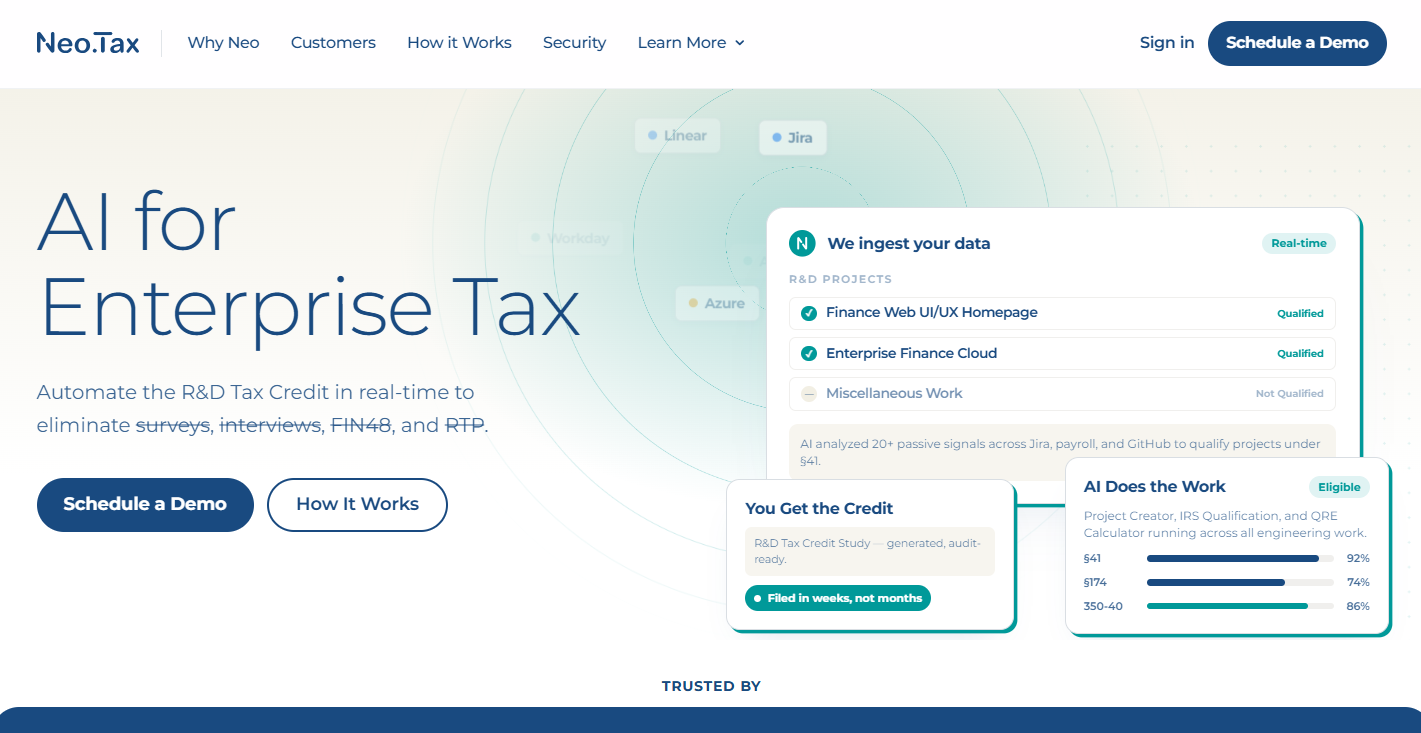
Neo.Tax turns engineering and payroll data into a calculated R&D credit, and it is built for enterprise tax teams that want the number pulled straight from their systems. It connects to sources like Jira, GitHub, payroll, and the ledger, reading passive signals across those systems so the workflow skips the surveys and interviews a study usually runs on. A set of AI agents then handles the steps: qualifying projects, quantifying activity, calculating QREs, and drafting narratives.
The output is an audit-ready R&D credit study, and Neo.Tax also produces related workpapers such as ASC 350-40 software capitalization and section 174 treatment. Because every figure traces back to a source system, the file shows where each number came from, which helps at review time.
What the tool does not do is resolve the legal authority questions that decide whether a close position survives a reviewer, so pair it with research when a position is contested.
Best for software and enterprise tax teams that want to quantify QREs directly from engineering and payroll data with minimal manual entry.
2. TaxCredit.ai
TaxCredit.ai is built for firms and businesses producing R&D studies at volume. It automates data intake, generates the study package, and prepares the filing forms, with the aim of compressing the hours a manual study consumes. Its primary job is estimation and study production across many clients.
The pull for a multi-client practice is throughput: repeatable intake and generated documentation that reduce the per-study hours when you run the same process again and again. As with the other estimation tools, the output rests on workflow logic rather than a citation trail to primary authority, so the defensibility of any single position still depends on your review.
Best for firms that run many studies and want to reduce the manual hours each one takes.
3. Exactera
Exactera pairs R&D credit software with provider support, sitting between pure software and a fully managed study. It calculates the credit, assembles a documentation package, and supports the four-part test analysis with guidance built into the workflow. The primary job is estimation, with a managed-service layer behind it.
That layer is the draw for firms that want software efficiency without owning every step alone. Exactera also covers R&D alongside other areas such as transfer pricing, which helps firms consolidating tax work with one provider. The guidance is provider-supported rather than traced to primary authority you can cite line by line, so a position that has to hold up on its own authority still needs research grounding.
Best for firms that want software efficiency with a managed-service layer behind the study.
4. Boast.ai
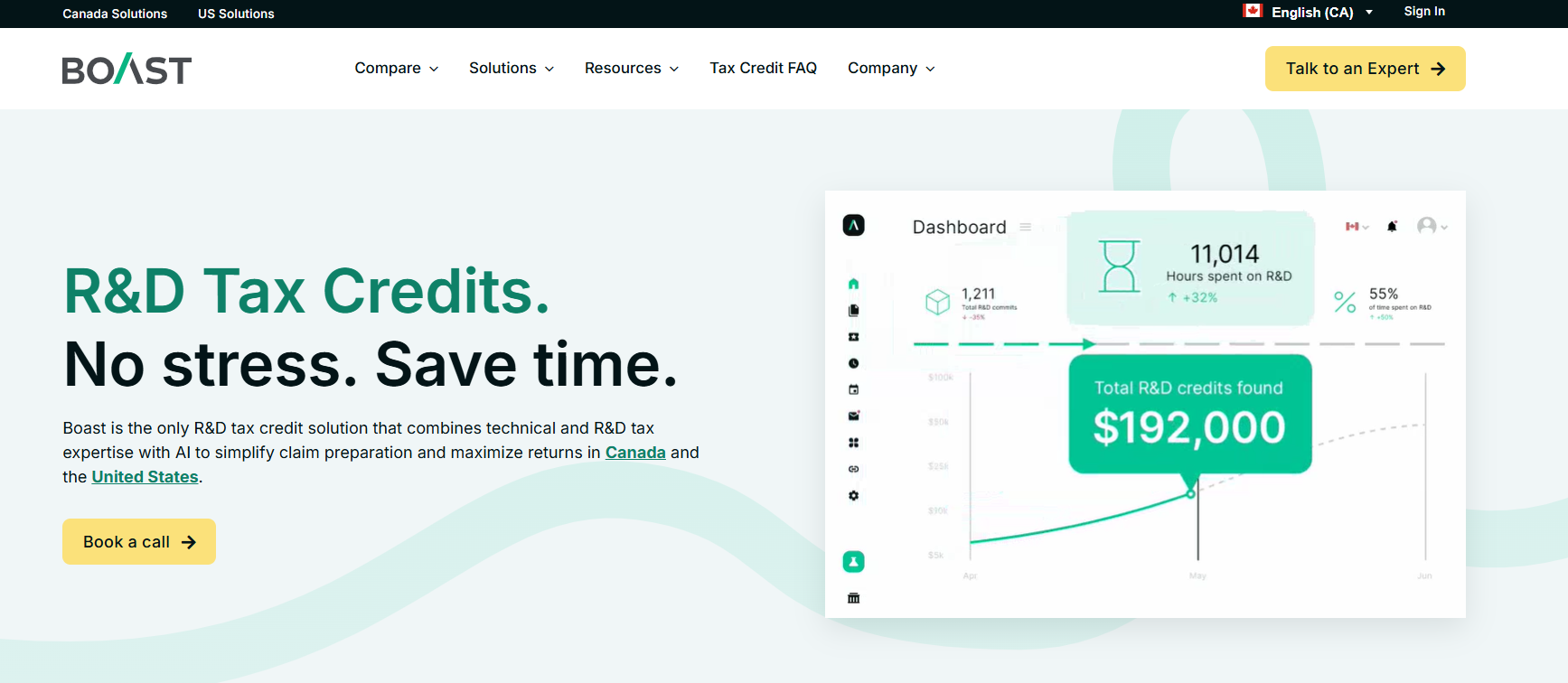
Boast.ai handles the full R&D claim process, pairing its software with an in-house team of technical and tax specialists. That combined model is common among startups that lack an in-house tax function and want the work done for them. Boast supports both US federal section 41 credits and Canadian claims, so it fits companies filing on both sides of the border.
The platform captures eligible activity across the development cycle rather than only at year-end, and its specialists check in to confirm what qualifies. You get real-time claim tracking and a digital audit binder, and its AuditShield service represents you if a tax authority examines the claim. Boast commonly works on a percentage-of-credit basis, so the cost scales with the size of the claim rather than a flat software fee.
The trade-off is the same as the rest of this group: the claim rests on provider assurance rather than a citation trail you can put in front of an examiner, so the authority behind a gray-area position is not the strength here.
Best for startups and smaller companies that want to outsource the entire claim rather than run it in house.
5. Swanson Reed TaxTrex

Swanson Reed is an R&D tax specialist firm, and TaxTrex is its documentation and record-keeping tool. It structures contemporaneous documentation and organizes the records behind a claim, backed by the firm's specialist review. The primary job here leans toward documentation workflow rather than a self-serve credit estimate.
For firms that value specialist input, the specialist-reviewed model is the point: the tool structures the file while an R&D-focused firm stands behind the work. Because contemporaneous records are what Form 6765 substantiation now leans on, a workflow built around record-keeping fits the direction the documentation rules are moving. The grounding is specialist assurance rather than primary authority you cite directly, so the legal-defensibility questions still call for research.
Best for firms that want specialist-guided documentation and record-keeping rather than a self-serve estimate.
6. Strike Tax
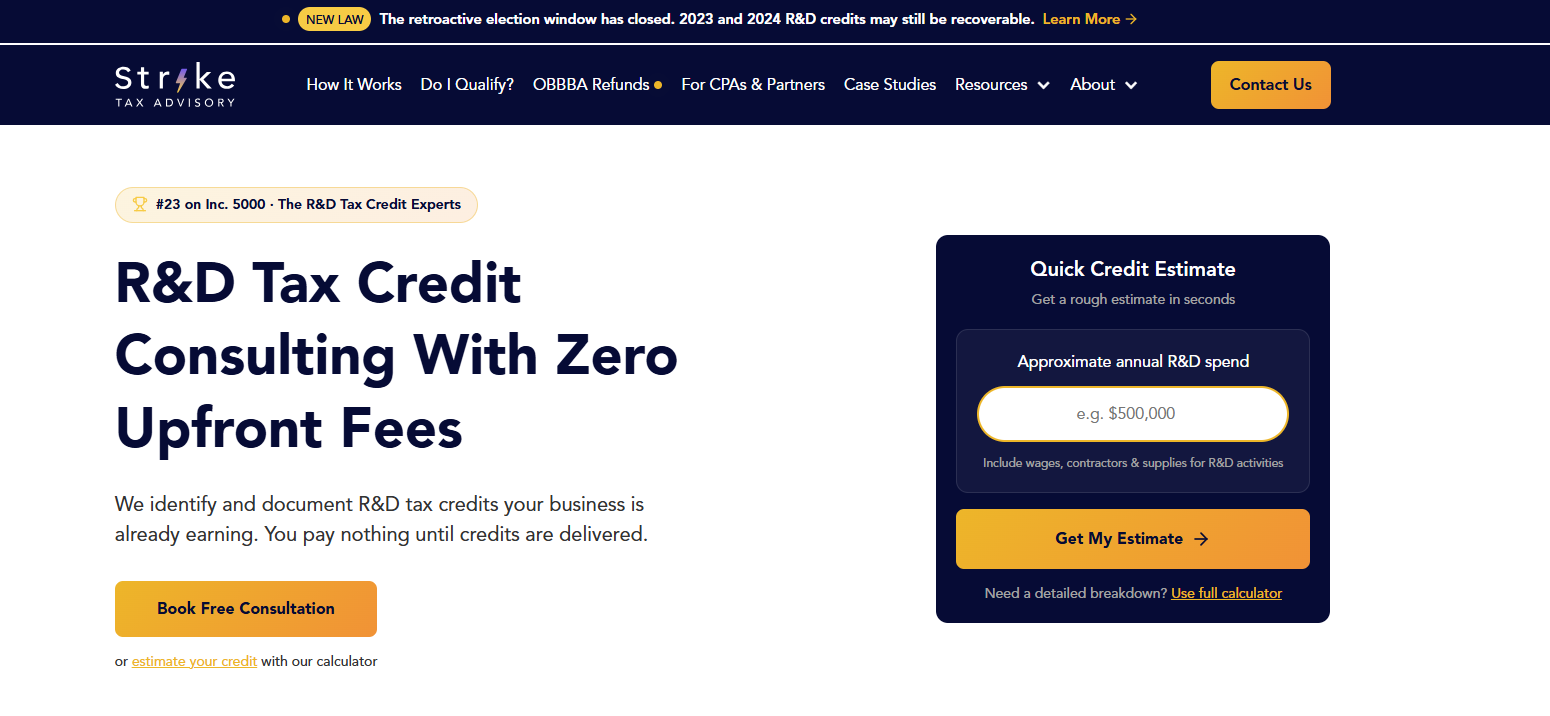
Strike Tax provides R&D credit studies on a done-for-you model, combining software with the firm's own analysis. It captures data, builds the study, and assembles the documentation package for filing. The primary job is estimation delivered as a managed study.
The appeal is offload: you hand over the process and receive a study and documentation package prepared for filing. Strike also publishes guidance content on section 174 and related rules, which signals attention to the shifting cost-treatment questions. As a provider-supported study, the output carries provider assurance rather than a citation trail to primary authority, so a contested position still benefits from independent research grounding.
Best for businesses that want a managed study and are comfortable handing off the process.
7. Incentify
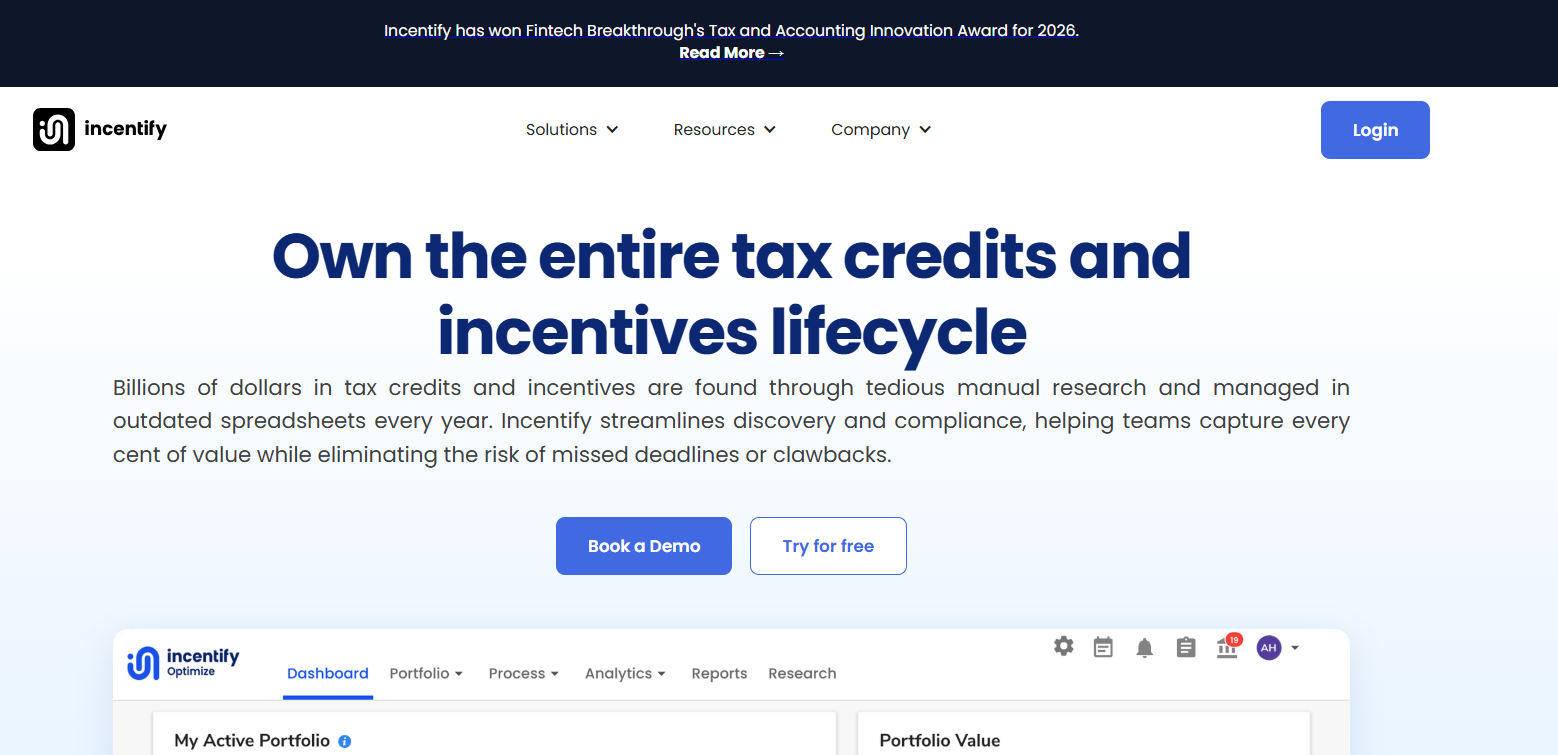
Incentify approaches R&D credits from a different angle than the other data-capture tools on this list: discovery rather than quantification. Its AI-native Explore engine matches a company's activity against more than 1,200 federal, state, and local credit and incentive programs, R&D credits included, but also green energy, workforce development, and zone-based incentives, surfacing what a business may be eligible for before anyone has run a formal QRE calculation.
That breadth is also the honest limitation for an R&D-specific workflow. Incentify identifies that an R&D credit opportunity likely exists and helps track and manage it once claimed, but it does not quantify QREs from engineering or payroll systems the way Neo.Tax or Exactera do, and it does not ground a section 41(d) position in primary authority the way Bizora does. KPMG holds a minority stake in Incentify and has built the platform into its own Incentive Credit Opportunity Navigator offering, and Ryan LLC has an exclusive partnership giving its C&I clients access to the platform, both signals of real enterprise adoption in the credits-and-incentives space specifically.
Best for firms and corporate tax teams that want to confirm which credits and incentives, R&D included, a company is actually eligible for before running a formal study.
8. Bizora
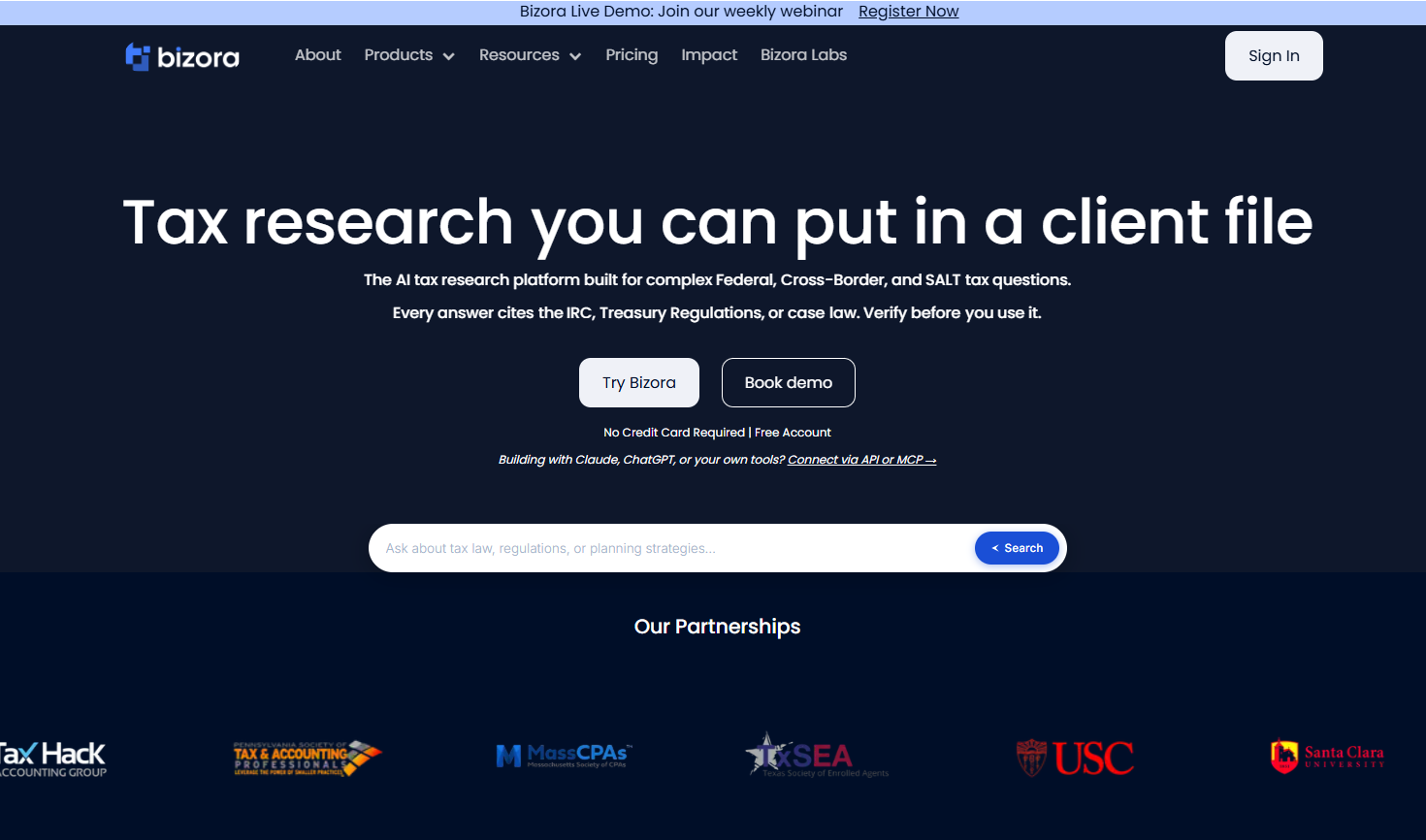
Bizora is an AI tax research platform built for CPAs, tax attorneys, and advisors doing high-stakes work where defensibility matters. On R&D credits it answers the legal questions behind the claim rather than self-estimating a credit from your engineering systems: whether an activity satisfies section 41(d), how the four-part test applies to a fact pattern, or what the current section 174A treatment is.
It pulls exclusively from primary authority (the Internal Revenue Code, Treasury Regulations, IRS rulings, and case law), and its View Steps feature shows the full reasoning path from question to conclusion. That gives you a trail you can put in front of a partner or defend under IRS scrutiny.
Bizora does not quantify QREs in product, and it does not scan for eligible incentives the way a discovery tool does. It offers a one-minute R&D qualification tool that gauges early whether a client likely qualifies, and eligible clients get referred to TaxHack (TaxHack Accounting Group), an R&D specialist advisory firm that handles the technical interviews, documentation, credit calculation, and filing. Pricing is public and per seat, from $29.99 to $119.99 per month with a 7-day free trial and no contract, and an API is available for firms embedding the reasoning engine into their own tools.
Best for firm managers and solo CPAs who need to ground the legal positions behind an R&D claim, screen qualification quickly, and refer execution to a specialist.
How we evaluated these tools
Every tool on this list earned its place against the same criteria, applied to the three jobs R&D credit work actually requires:
- Primary job: Whether the tool captures and estimates the credit, grounds the legal positions behind it, or identifies eligibility before either of those steps starts. This matters because R&D work spans distinct jobs, and a tool built to pull QREs from your systems answers a different question than one built to defend a position or one built to find the opportunity in the first place, so knowing the primary job tells you where a tool fits.
- Authority grounding: Whether outputs trace to primary authority you can cite and verify, or rest on workflow logic, provider assurance, or a proprietary incentives database. It matters because a credit hinges on whether an activity meets the section 41(d) tests, and tools differ sharply here: some cite the Code and regulations directly, while others give you a number, a process, or an eligibility match without the authority a reviewer can check.
- Documentation output: What the tool produces for the file, from credit calculations and filing forms to source-cited memos, reasoning trails, or eligibility reports. The output shapes what you can put in front of a partner or an examiner, and the tools split between filing-ready calculations, citation-backed research, and portfolio-level eligibility tracking.
- Defensibility under review: Whether the output supports partner review and holds up if the IRS examines the claim. This is the point of substantiation, and it separates tools whose output carries provider assurance from those that expose a reasoning path you can trace source by source.
- Honest fit: Where each tool is genuinely strong and where it falls short. No single tool covers the estimation, research, and discovery jobs at once, so the honest read on each tool's limits is what lets you pair the right ones rather than expecting one to do everything.
We did not rank tools on marketing claims. We assessed what each does for the substantiation that has to survive a reviewer.
How the four-part test works in practice with primary-authority research
Say a manufacturing client asks whether their internal tooling project qualifies. You need to apply the section 41(d) four-part test and document the cited position for the file. Here is a walkthrough using a primary-authority research tool.
- Frame the question. Ask directly: "Does developing proprietary production tooling satisfy section 41(d)?" The query should name the activity and the test so the tool returns authority on point.
- Check the citations returned. The tool should return IRC section 41(d)(1) and Treas. Reg. section 1.41-4 as the grounding authority. If a response leans on a summary or a generic explanation without pointing to these cites, treat that as a gap, not a finished answer.
- Confirm all four elements against the output. The activity needs a permitted purpose (new or improved function, performance, reliability, or quality), technological in nature (fundamentally relies on principles of the physical or biological sciences, engineering, or computer science), elimination of uncertainty (whether the capability, the method of achieving the result, or the appropriate design of the result was uncertain at the outset, per Treas. Reg. section 1.41-4(a)(3) and the corresponding process-of-experimentation standard in section 1.41-4(a)(5)), and a process of experimentation (evaluation of one or more alternatives). Each element must trace to a regulation cite, not a summary.
- Document the position. Pull the relevant passages from View Steps, note which regulation sections ground each element, and record your conclusion with the cite trail. The file should show exactly what authority supports the position if a reviewer or examiner asks.
That documented position, built from primary authority and your professional judgment, is what separates a defensible claim from one that rests on workflow logic alone. The estimation tool gives you the number; this step gives you the authority behind it.
Matching the right tool to your R&D credit workflow
Start by matching the tool to the job in front of you. If you are not yet sure whether R&D credits or other incentives apply, a discovery tool like Incentify can confirm eligibility across a broad set of programs before anyone runs a formal study.
If you need to pull QREs out of payroll and engineering systems and quantify the credit, a data-capture tool like Neo.Tax, TaxCredit.ai, Exactera, Boast.ai, Swanson Reed TaxTrex, or Strike Tax will save real hours on the calculation.
If you need to answer the authority questions that decide whether a position is defensible, a research tool grounded in primary authority is the better fit, and this wider comparison of tax research software covers the research options beyond the R&D-specific ones here. Most firms need at least two of these three jobs covered.
On the research side, Bizora answers the legal questions behind the claim with source-cited output and a View Steps trail you can put in front of a partner or an examiner. For R&D specifically, its one-minute qualification tool screens whether a client likely qualifies, and eligible clients get referred to TaxHack for the technical study, documentation, and filing. It stays a supplemental tool that amplifies your judgment, not a shortcut around the review you own. If that research layer is the gap in your current workflow, start a free trial at bizora.ai and test a section 41(d) question against your own fact pattern.
Frequently Asked Questions
Which AI tools actually estimate the R&D credit, and which defend it?
They split by job. Estimation tools like Neo.Tax, TaxCredit.ai, Exactera, Boast.ai, Swanson Reed TaxTrex, and Strike Tax quantify QREs from payroll and engineering data and build the credit calculation under section 41. A primary-authority research tool like Bizora grounds and defends the positions behind that number, answering whether an activity satisfies the section 41(d) tests and how a cost is treated. Most firms use one from each side: an estimation tool for the number, a research tool for the authority that holds it up.
What are the best AI tools for R&D tax credit documentation?
The strongest options split by job. For capturing QREs and producing the study package, tools like Neo.Tax, TaxCredit.ai, and Exactera automate data intake and Form 6765 support. For documentation you can defend, a primary-authority research tool like Bizora grounds each position in cited source material, which matters more now that Form 6765 Section G reporting becomes required for tax year 2026 per the IRS Form 6765 instructions.
Which AI handles R&D tax credit documentation with four-part test analysis?
Estimation tools map captured activities to the four-part test as part of building the credit. For the legal analysis of whether an activity satisfies section 41(d), including the process of experimentation requirement in Treas. Reg. section 1.41-4, a research tool that cites primary authority is better suited. Bizora answers those questions with a reasoning trail, though a credentialed professional must still review and sign the position.
How is a discovery tool like Incentify different from an estimation or research tool?
Discovery tools confirm whether a company is eligible for R&D credits and other incentives at all, before anyone quantifies a specific credit or defends a specific legal position. Incentify matches a company's activity against more than 1,200 federal, state, and local programs to surface that opportunity, but it does not calculate a precise QRE-based credit or cite primary authority to defend the position. Firms typically need a discovery tool alongside an estimation or research tool, not instead of one.
Can AI-generated documentation survive an IRS audit?
AI output is only as defensible as the authority and review behind it. The IRS has expanded its use of AI in audit selection, which raises the bar for substantiation that traces to primary authority. Documentation grounded in the Internal Revenue Code, Treasury Regulations, and case law, with a visible reasoning path and professional review, is far more defensible than a confident summary with no citation trail.
Does AI R&D software mean you no longer need a tax professional?
No. Every tool here, including Bizora, is a supplemental tool that amplifies professional judgment, not a substitute for it. The practitioner who signs the return under Circular 230 owns the position, and AI accelerates the research and documentation rather than removing the review. Treat any tool as an assistant to your judgment, then verify each position against the cited authority before you file.