What's New in Bizora: July 2026
Tax research moves fast. Rulings drop, IRS guidance shifts, and the cases that define how a position holds up in court keep accumulating. The July 2026 Bizora update addresses three of the gaps practitioners have asked about most: Tax Court coverage, access to recent web updates, and a clearer way to visualize the conditional logic behind complex answers.
Here's what's new.
Key takeaways:
- Bizora now supports Tax Court cases directly in its research database
- Controlled web search fills the 3–4 day knowledge gap for recent IRS updates and regulatory changes
- Searches are restricted to pre-approved authoritative sources only, with no noise and no unreliable results
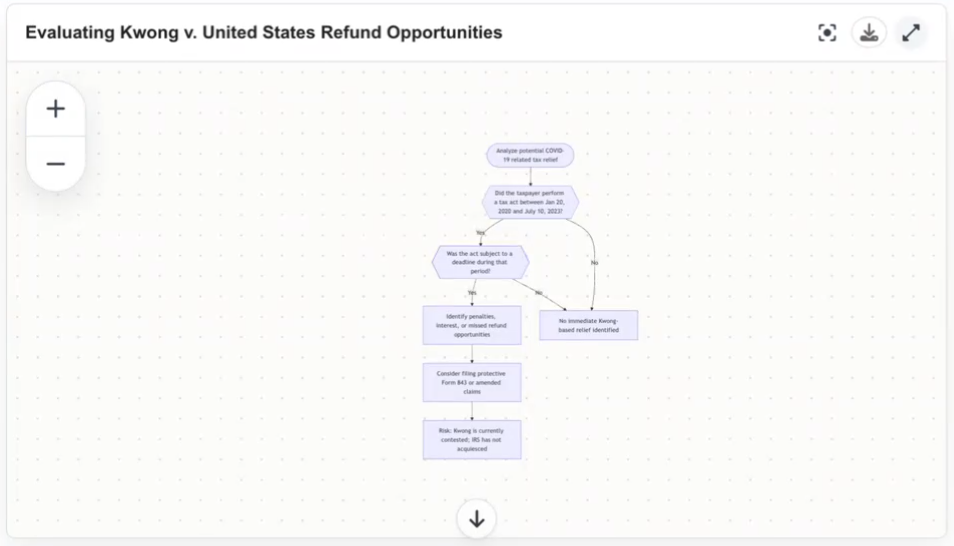
- Visual decision trees now appear in responses to map conditional tax logic step by step
- A referral program lets users earn rewards for bringing colleagues onto the platform
- All four updates are live now for existing subscribers
Four Updates Live in July 2026
This month's release covers two gaps in research coverage, one improvement to how answers are explained, and one new way to put Bizora in front of colleagues who need it. Here's what each one does.
Tax Court Cases Are Now in the Bizora Database
Tax Court opinions are some of the most cited authorities in practice. When a client's position depends on how a court ruled in a similar fact pattern, you need that case, not a summary of it.
Bizora now pulls directly from the Tax Court pipeline, adding U.S. Tax Court cases to the research database alongside the IRS code, regulations, rulings, and guidance it already covers. That means when you ask a question involving disputed positions, contested deductions, or fact-pattern-dependent analysis, Bizora can surface the relevant case law alongside statutory authority.
For practitioners doing audit defense, penalty abatement work, or research on positions where the Tax Court has weighed in repeatedly, this is the update that matters most this month.
Controlled Web Search: Bridging the Last 3–4 Days
Tax law has a timing problem. IRS guidance, regulatory releases, and legislative updates move faster than any static database can keep pace with. The gap between "published" and "indexed" is usually small, but in tax practice, small gaps cost clients money.
The July update introduces controlled web search. When enabled through Bizora's settings, the AI Assistant can automatically perform web searches when it detects a knowledge gap, specifically for updates and changes from the last three to four days.
The key word is controlled. Searches are restricted to pre-approved authoritative websites. You're not getting Reddit threads or tax blog speculation in your results. You're getting the primary sources that practitioners actually rely on, surfaced at the moment the question requires them.
This is the difference between an AI tool that confidently states outdated information and one that knows when to go look something up.
Visual Decision Trees for Complex Conditional Logic
Tax answers are rarely linear. Eligibility questions, phase-out calculations, and multi-factor tests all involve conditional logic: if A, then B, unless C, in which case D applies. Explaining that in prose works, but following it is another matter.
Bizora responses can now include visual decision trees that map the conditional logic behind an answer. You see the branches, not just the conclusion. For questions involving qualification tests, material participation, passive activity rules, or any analysis that depends on a series of yes/no determinations, the decision tree turns a wall of conditions into a path you can actually follow.
This connects directly to the View Steps transparency Bizora already provides. Now the reasoning isn't just traceable in text. It's visible as a diagram.
Referral Program
Users can now refer Bizora to colleagues and earn referral rewards. If you've found the platform useful, the referral program is in your account settings.

What These Updates Mean for Your Research Workflow
The Tax Court pipeline and controlled web search solve the same underlying problem from two directions: making sure the answer you get reflects the full picture of current authority, not just the easiest-to-index portion of it.
Visual decision trees solve a different problem. The gap between understanding an answer and being able to apply it is real. When a client asks whether they qualify for something, you don't just need to know the answer. You need to be able to walk them through the reasoning. Decision trees make that easier.
Taken together, these updates move Bizora closer to what practitioners actually need from an AI research tool: complete coverage, current awareness, and answers that are as easy to explain as they are to reach.
Frequently Asked Questions
What is the Bizora July 2026 update?
The July 2026 update adds Tax Court case support to Bizora's research database, introduces controlled web search for recent regulatory changes, adds visual decision trees to AI responses, and launches a referral program.
Does Bizora now cover Tax Court cases?
Yes. As of the July 2026 update, Bizora's database includes U.S. Tax Court cases alongside IRS code, regulations, rulings, and guidance.
How does Bizora's controlled web search work?
When enabled in settings, Bizora automatically searches pre-approved authoritative websites when it detects a knowledge gap, specifically for updates from the last three to four days. Searches are restricted to vetted sources only.
What are visual decision trees in Bizora?
Visual decision trees are diagrams that appear in Bizora responses to map the conditional logic behind a tax answer, showing the branching conditions and outcomes step by step rather than describing them in prose alone.
Who can use the new July 2026 features?
All features are available to current Bizora subscribers. Controlled web search must be enabled through account settings.