Audit research tools compared: CoCounsel, Accounting Research Manager, Checkpoint, the Big Four resources, and Bizora
Audit and accounting teams choosing a research tool usually start with a few names. Accounting Research Manager, CoCounsel, Checkpoint, PPC Guides, and the free Big Four resources all come up. This comparison puts each one next to Bizora Audit Research.
It draws the line the top search results skip: research tools that find and cite the standard, versus workflow software that manages the engagement. Coverage is the gap most comparisons leave open. Many tools are strongest in U.S. GAAP and SEC guidance, while government, compliance, and cross-authority questions often require additional modules, manual research, or separate sources.
Below, each tool gets a fair account of what it covers, who it suits, and where it stops. A single comparison table follows, then a recommendation tied to your firm's actual work.
Key takeaways
- In scope: CoCounsel Audit & Accounting, Accounting Research Manager, PPC Guides, Checkpoint Edge and Guided Assurance, and the free Big Four resources, measured against Bizora.
- Excluded: DataSnipper and AuditBoard are testing and workflow tools, not primary-authority research tools, so they sit outside this comparison.
- Definition: an audit research tool answers what a standard requires and where to find it, cited to source, so you can defend the position.
- Coverage limit: government and compliance authorities like GASB, Uniform Guidance, GAGAS, and FAR are where coverage often becomes module-dependent, incomplete, or harder to reconcile across tools.
- Cross-authority work: the key differentiator is whether a tool can hold several authorities open at once and show where they interact or diverge.
- The stakes: GAO reported that the Federal Audit Clearinghouse contained about 40,000 single audit submissions covering more than $1.1 trillion in federal awards for fiscal year 2023.
What is an audit research tool, and what is it not?
An audit research tool answers two questions: what does a standard require, and where is it written. Each answer is cited to source, so you can defend it. It finds and explains authoritative guidance, and it does not manage the engagement.
Workflow, documentation, and testing software do a different job. They organize the audit file, track sign-offs, and tie out numbers, but they do not tell you what GASB or the Uniform Guidance actually requires. That reaching-the-standard job is what accounting research software is for.
DataSnipper and AuditBoard are not in this comparison for that reason. They are testing and workflow tools, not primary-authority research, covered separately in our category map of audit software for small CPA firms.
Consider a concrete requirement. Under 2 CFR 200.501, a non-Federal entity that expends $1,000,000 or more in Federal awards during its fiscal year must have a single audit or, when permitted, a program-specific audit. That figure applies to fiscal years beginning on or after October 1, 2024, raised from $750,000; the Clearinghouse volume above predates the change.
Our full breakdown of single audit requirements covers the mechanics in depth, but the point here is narrower: a research tool has to reach that rule, cite it, and show the version in force.
Audit research tools compared, tool by tool
Here is each tool on its own terms: what it covers, who it suits, and where it stops. The detailed table comes in the next section.
1. CoCounsel Audit & Accounting: the AI-native incumbent
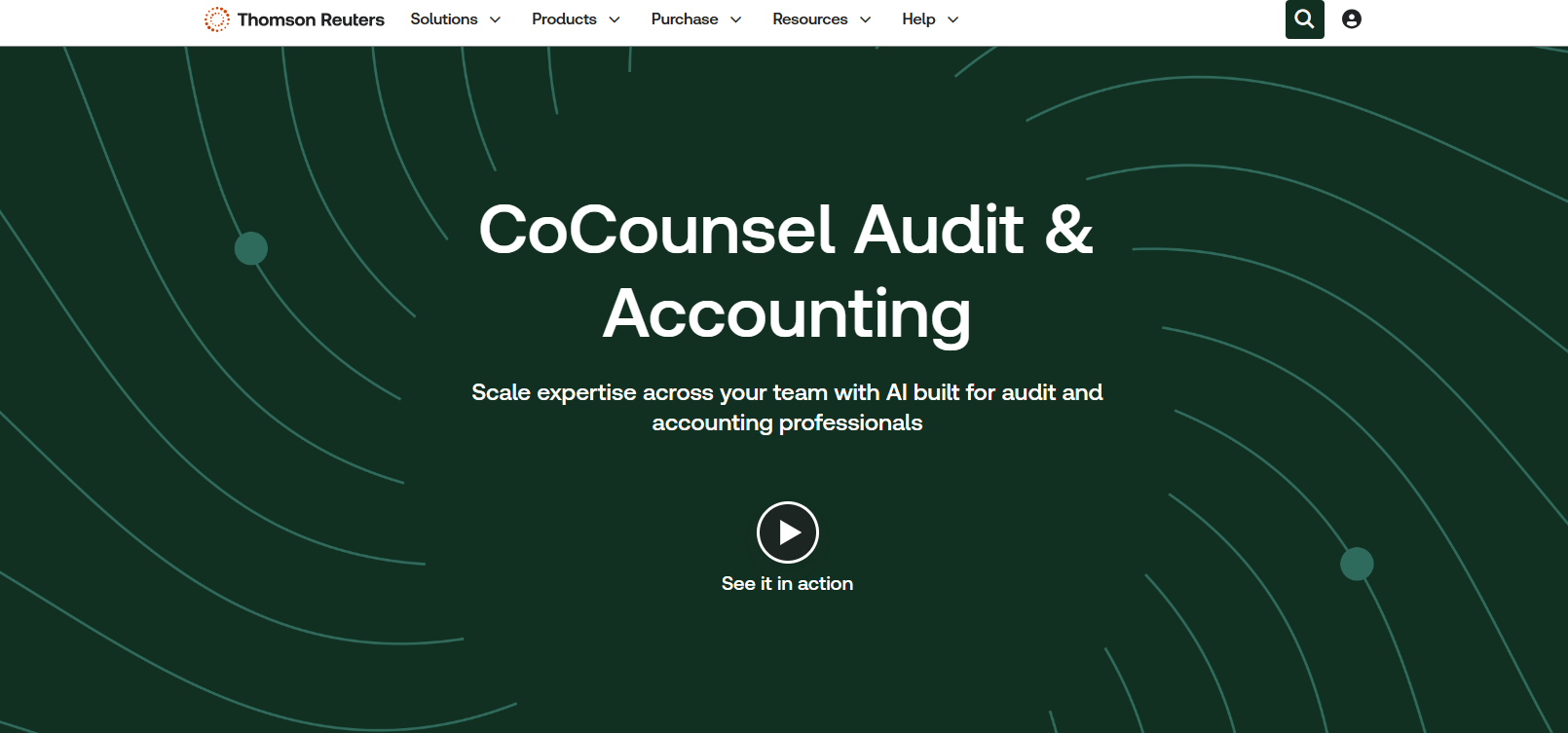
CoCounsel Audit & Accounting is Thomson Reuters' AI-native research assistant for audit and accounting questions, built on the same CoCounsel platform Thomson Reuters uses across its tax and legal products. It gives teams access to Checkpoint content, FASB, GASB, AICPA, IFRS, Checkpoint Catalyst, and PPC guides from inside one workspace, and Thomson Reuters reports the broader CoCounsel platform is now in use at more than 1,300 firms.
Give it credit. An AI-native assistant tied to that much established content is a real advantage for firms already reading Thomson Reuters guidance, and its focus on core accounting and audit research makes it a serious option for teams whose work stays inside GAAP and U.S. auditing standards. For firms already standardized on Thomson Reuters content, that existing ecosystem familiarity counts for a lot.
Key features:
- AI-native conversational research built directly into the Thomson Reuters CoCounsel platform, not bolted on afterward
- Single workspace access to Checkpoint content, FASB, GASB, AICPA, IFRS, Checkpoint Catalyst, and PPC guides, so you're not switching tools mid-question
- Part of the broader CoCounsel platform, which Thomson Reuters reports is in use at more than 1,300 firms
Best for: firms already reading Thomson Reuters guidance whose work stays inside GAAP and U.S. auditing standards.
2. Accounting Research Manager: coverage, strengths, and who it suits
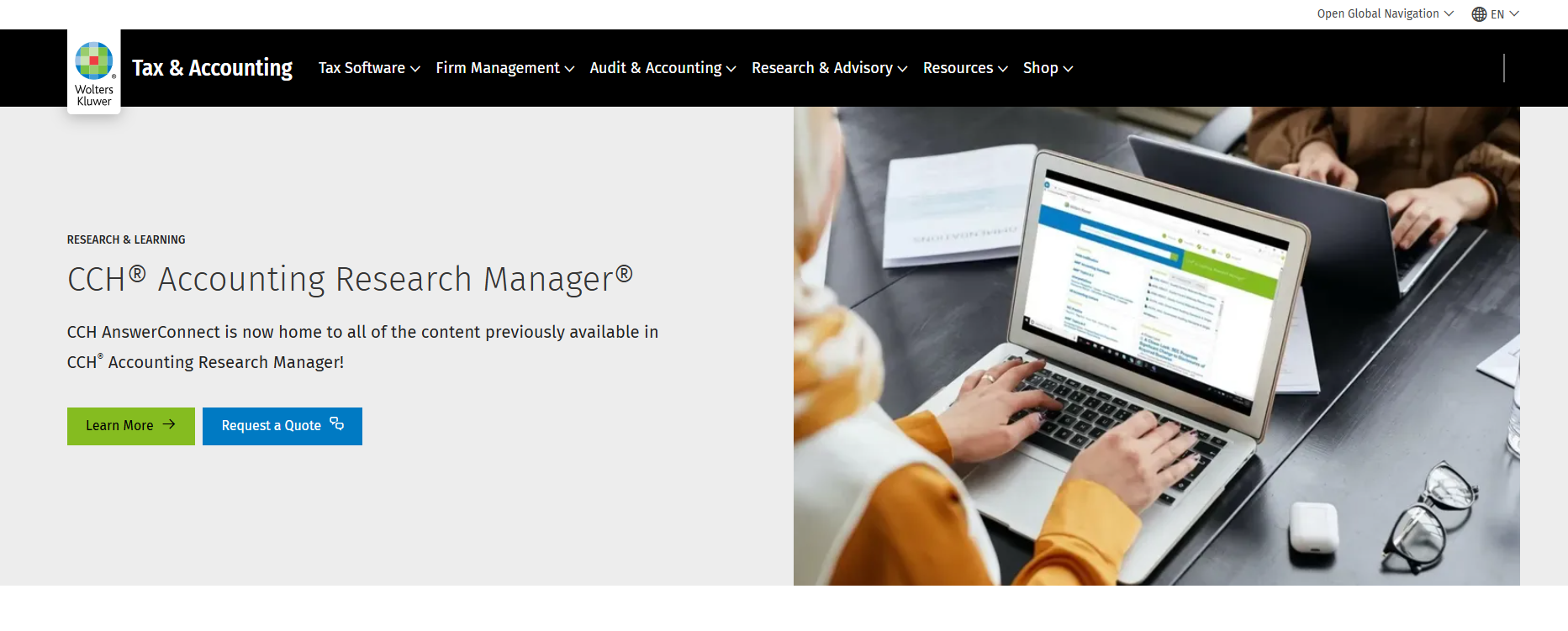
Accounting Research Manager (ARM) is CCH's long-running accounting and auditing research database from Wolters Kluwer, built on editorial depth across U.S. GAAP and auditing standards. It's not a retired product: Wolters Kluwer continues to actively update and sell ARM content, now delivered through a dedicated Accounting & Audit tab inside the CCH AnswerConnect platform rather than as a separate standalone application, with GenAI summaries and an AI Assistant layered on top.
Those summaries speed reading, but they're summaries; the editorial citations underneath remain the thing you cite and defend. Its editorial interpretation is genuinely strong, and the best fit is a firm already inside the CCH and Wolters Kluwer ecosystem whose work centers on accounting and tax rather than government and compliance authorities.
Key features:
- Editorially curated interpretive guidance written by Wolters Kluwer's own team, not just AI-generated summaries
- ARM Topics A-Z, organized by FASB Codification section for fast browsing
- Delivered through CCH AnswerConnect's dedicated Accounting & Audit tab, rather than as a separate standalone application
- GenAI summaries and an AI Assistant layered on top of the editorial content for faster reading
Best for: firms already inside the CCH and Wolters Kluwer ecosystem whose work centers on accounting and tax rather than government and compliance authorities.
3. PPC Guides: methodology and practice aids, not primary research

PPC Guides, from Thomson Reuters, are practice aids and audit programs built around a methodology. They walk a team through how to run an engagement, with checklists, programs, and workpaper templates.
This is a different job from primary-authority lookup, and PPC is genuinely strong at it. Bizora doesn't replace it; the two solve different problems. A firm that runs its audits on PPC methodology should keep doing so, with a research tool alongside it answering the standard-level questions the practice aids point to.
Key features:
- Engagement checklists and audit programs that walk a team through a specific engagement type step by step
- Workpaper templates built around Thomson Reuters' own methodology
- References standards inside the practice aids themselves, rather than functioning as a standalone authority lookup
- Often accessed through Thomson Reuters / Checkpoint subscription packages, depending on product configuration
Best for: firms that want standardized methodology and checklists handled, paired with a separate research tool for the standard-level questions the practice aids point to.
4. Checkpoint Edge and Guided Assurance: where they overlap and where they don't
Checkpoint Edge is Thomson Reuters' broader AI-powered research platform, now often marketed as "Checkpoint Edge with CoCounsel." Checkpoint Engage, the audit engagement and research layer that used to sit alongside it, was rebranded Guided Assurance in August 2025; if you're comparing an older quote or review, check whether it reflects the current Guided Assurance offering.
Both overlap with Bizora on single-authority lookup: find a standard, read it, cite it. That overlap is real and useful. Where the comparison becomes harder is cross-authority reconciliation: holding GASB, the Uniform Guidance, and GAGAS together in one answer and showing how they interact on the same question.
Key features:
- Checkpoint Edge's broad AI-powered research across accounting, audit, and tax content, often marketed as "Checkpoint Edge with CoCounsel"
- Guided Assurance's embedded engagement methodology, including guided single audit workflow steps built directly into the file
- Single-authority lookup across both products, so a standard is found and cited without leaving the platform
Best for: firms that want single-authority lookup and embedded engagement methodology from the same vendor, without needing cross-authority reconciliation across GASB, Uniform Guidance, and GAGAS at once.
5. The free Big Four resources: Viewpoint, DART, FRV, and AccountingLink
PwC Viewpoint, Deloitte DART, KPMG FRV, and EY AccountingLink are free accounting research resources from the Big Four. For U.S. GAAP and SEC topics, they're well maintained and often cite directly to authoritative standards, SEC rules, and SEC staff guidance.
Their limits are structural. Their free coverage is concentrated in GAAP and SEC reporting, rather than government, single-audit, contracting, or compliance authorities, and they aren't designed as cross-authority reconciliation tools or API-first research infrastructure.
Key features:
- Free access with no subscription cost
- Curated interpretive guidance focused on U.S. GAAP and SEC topics
- Direct citations to authoritative standards, SEC rules, and SEC staff guidance
- No API, so integration into an existing workflow has to happen manually
Best for: firms whose work stays in GAAP and SEC reporting and want free, well-maintained interpretive guidance without government or compliance coverage.
6. Bizora: coverage, citation behavior, and the cross-authority case
Bizora Audit Research covers U.S. GAAP/SEC, PCAOB/AICPA, government and public sector (GASB, GAO Yellow and Green Book, FASAB, 2 CFR 200), government contracting (FAR, DFARS, CAS, DCAA), specialized industries (ERISA/EBSA, NAIC, FFIEC), and international standards (IFRS, IAASB, IESBA) in one platform.
Every answer is cited to the specific standard, section, and paragraph, with a reasoning trail showing which authorities were used, and superseded standards like ASC 605 and ASC 840 are flagged with the current revision and effective date.
Where this differs from the tools above: a government contractor that's also an SEC registrant can hit FAR 31.205-6 on compensation allowability and Regulation S-K Item 402 on compensation disclosure in the same year. Bizora holds both open and shows where they diverge; the allowability conclusion itself stays your determination, not the tool's.
Key features:
- Coverage across GAAP/SEC, PCAOB/AICPA, government, contracting, specialized industries, and international standards, in one platform
- Every answer cited to the specific standard, section, and paragraph behind it, not just a general reference
- Superseded-standard flagging with the actual revision and effective date shown in the answer
- View Steps reasoning trail showing which authorities were used and how they connect
Best for: firms whose practice mix crosses multiple standard-setters on the same engagement, especially single audit and government-contract work. Included with Pinnacle subscriptions on the web app, or billed at $0.65 per query via the API and MCP server.
Where the workflow tools fit, and why they aren't in this comparison
Caseware and its alternatives manage the engagement file itself: trial balance import, lead schedules, risk assessment forms, staff scheduling, and sign-off routing all live inside one file the whole team works from. DataSnipper works inside Excel to tie workpaper figures directly to source documents, the same tick-and-tie a person would otherwise do by hand. AuditBoard runs GRC and internal-audit workflow for larger, more process-heavy shops, tracking controls, risk registers, and audit programs across an organization.
Each of these does real, valuable work, and none of them answer what a standard requires or where it's written. That's the category boundary: a workflow tool organizes the audit and moves the file forward, while a research tool tells you what the standard says and cites it. The two jobs get bundled together constantly in vendor marketing, which is exactly why a firm ends up owning a workflow tool, assuming it also covers primary-authority research, and discovering mid-engagement that it doesn't.
Because they answer a different question, Caseware, DataSnipper, and AuditBoard sit outside this comparison. The category map linked above covers the workflow-tool decision in full, including pricing and firm-size fit.
Audit research tools compared: authorities, citations, pricing, and API access
The table below is the side-by-side the top search results skip, with citation behavior noted for each tool. Pricing reflects Bizora's published pricing and public listings only; where a vendor doesn't disclose pricing, the table says so.
| Tool | Authorities covered | Citation to source | Superseded handling | Pricing model | API access |
|---|---|---|---|---|---|
| CoCounsel Audit & Accounting | Accounting and auditing research through Thomson Reuters content; specific coverage depends on subscription and product configuration | Cites to Thomson Reuters content | Not publicly documented | Not publicly disclosed | Not publicly disclosed |
| Accounting Research Manager | U.S. GAAP and auditing standards on CCH AnswerConnect | Cites editorial and primary content | Editorial archive; behavior not publicly documented | Not publicly disclosed | Not publicly disclosed |
| PPC Guides | Practice aids and audit programs, not primary-authority lookup | References standards within practice aids | Updated on the guide revision cycle | Not publicly disclosed | Not publicly disclosed |
| Checkpoint Edge / Guided Assurance | Broad tax, accounting, audit, and engagement content through Thomson Reuters offerings; specific coverage depends on subscription and product configuration | Cites to source | Not publicly documented | Not publicly disclosed | Not publicly disclosed |
| Big Four resources (Viewpoint, DART, FRV, AccountingLink) | GAAP and SEC-focused firm guidance; limited or no coverage of government, single-audit, contracting, or compliance authorities | Cites to standards and firm interpretations | Varies by resource | Free | No public research API |
| Bizora Audit Research | GAAP/SEC, PCAOB/AICPA, government, contracting, specialized, international | Cited to specific standard, section, and paragraph | Flagged as superseded with pointer to current guidance | Included with Pinnacle; $0.65/query via API | Yes |
Which audit research tool fits which firm profile
The right tool depends on what your work crosses. Use this as a starting point, and see how to evaluate research software for a fuller checklist.
- Solo or small mixed practice: if your work spans GAAP, government, and contracting, one cited cross-authority tool beats stitching together several logins.
- Heavy government or single-audit book: Bizora reaches GASB, the Uniform Guidance, and GAGAS, and reconciles them in one answer.
- Already inside CCH or Checkpoint: if your work stays in accounting and GAAP, the incumbent you own may be enough.
- Committed to PPC methodology: keep PPC for the engagement method, and add a research tool for the standard-level questions it points to.
- Need programmatic access: Bizora offers an API; the Big Four resources and most incumbents don't publish one.
The right tool depends on what your engagements cross
If your work stays inside GAAP and SEC reporting, Accounting Research Manager or a free Big Four resource may cover it. If it crosses government, compliance, and contracting authorities in the same file, cross-authority reconciliation with cited, currency-flagged answers is where Bizora fits.
Test it on a real question your team is arguing about this week, one that touches more than one authority. Try Bizora free today!
Frequently Asked Questions
Is CoCounsel the same as Checkpoint?
No. CoCounsel Audit & Accounting is Thomson Reuters' AI-native assistant, while Checkpoint Edge and Guided Assurance are its separate research and engagement platforms.
Does Accounting Research Manager cover government auditing standards?
Accounting Research Manager is best known for U.S. GAAP and accounting/auditing research within the Wolters Kluwer ecosystem. Because government-audit coverage can depend on product configuration, subscription content, and current platform packaging, confirm that your subscription reaches the specific Yellow Book, Uniform Guidance, GASB, and Compliance Supplement materials you need before relying on it for a GAGAS or single audit question.
What is the difference between Checkpoint Edge and Guided Assurance?
Checkpoint Edge is the broader AI-powered research platform, while Guided Assurance (formerly Checkpoint Engage) is the audit engagement layer that embeds methodology, including guided single audit workflows, directly into the engagement steps.
Are the Big Four accounting research resources really free?
Yes. PwC Viewpoint, Deloitte DART, KPMG FRV, and EY AccountingLink are free accounting research resources, though their free coverage is concentrated in GAAP and SEC topics rather than government, single-audit, contracting, or compliance authorities.
Can PPC Guides replace a primary-authority research tool?
No. PPC Guides provide audit methodology and practice aids, not primary-authority lookup, so they work best alongside a research tool rather than in place of one.
Does Bizora have an API for audit research?
Yes. Bizora Audit Research is available through an API and MCP server, billed at $0.65 per query regardless of how many authorities it consults.