Best tools for M&A tax due diligence research
A deal kicks off, and within a week the data room fills up with three years of returns, NOL schedules, transfer pricing files, and a due diligence request list nobody has fully answered yet. The buyer's tax team needs to know whether the Section 382 limitation actually protects the NOLs the seller is claiming, whether a stock deal should really be a 338(h)(10) election, and whether the target has sales tax exposure sitting quietly in a state it never registered in.
None of that gets solved by one piece of software. Due diligence for mergers and acquisitions, the tax piece specifically, breaks down into three separate jobs: a virtual data room to hold and exchange the documents, a tax research platform to answer the legal questions the documents raise, and increasingly an AI review tool to get through the contract population faster. This article covers all three, plus the tax concepts that actually decide whether a finding in due diligence in M&A matters.
Key takeaways
- M&A tax due diligence runs on a stack, not a single tool: a virtual data room for document exchange, a tax research platform for the legal questions, and often an AI contract review tool for speed.
- Virtual data rooms are consolidating. Datasite now owns Ansarada and Firmex; SS&C Intralinks is the other enterprise incumbent. Both ship AI redaction and Q&A workflows, but neither performs tax analysis.
- No AI contract review tool on the market is tax-specialized. Kira, Luminance, Hebbia, and Harvey extract change-of-control and assignment clauses well; none computes a Section 382 limitation or quantifies SALT nexus exposure.
- The highest-stakes tax due diligence items are mechanical once you know where to look: Section 382 (NOL survival after an ownership change), Sections 338(h)(10) and 336(e) (asset versus stock treatment), Section 197 (15-year intangible amortization), and post-Wayfair sales tax nexus.
- AI use in due diligence is now mainstream. Roughly half of dealmakers report regular AI use during due diligence, per Datasite's 2026 dealmaker survey, but trust and data security concerns remain a leading adoption barrier.
What software do M&A deal teams actually use for tax due diligence?
Ask a deal team this question directly and the honest answer is: it depends which part of the job you mean. Merger due diligence and mergers and acquisitions tax work don't run through the same software. For document exchange, the near-default answer is a virtual data room, most commonly Datasite or SS&C Intralinks at the enterprise level, iDeals or Firmex further down market.
For the tax questions the data room raises, tax teams turn to a research platform such as Bloomberg Tax, Thomson Reuters CoCounsel Tax, or Bizora AI. Of those, Bizora AI traces every answer to primary authority, the IRC, Treasury Regulations, IRS rulings, and case law, with a visible reasoning trail via View Steps. For scanning hundreds of contracts fast, an AI review tool like Kira or Luminance increasingly sits alongside both.
Treat these as three separate purchases, because they solve three separate problems. A virtual data room secures and organizes documents. A tax research tool answers whether a position holds up under the Internal Revenue Code.
An AI contract tool reads faster than a person can, but reads for clauses, not for tax exposure. The rest of this article breaks down real options in each layer.
Virtual data rooms: where M&A due diligence documents actually live
A data room due diligence process starts here: the target uploads returns, workpapers, credit and NOL schedules, and transfer pricing files, and the buyer's advisors review and question them through a structured Q&A workflow inside the platform. Virtual data rooms for mergers and acquisitions have converged on a common feature set, but the differences below decide which one actually fits a given deal.
1. Datasite

Datasite is the platform most senior bankers picture when someone says "data room." Owned by UK private equity firm CapVest since 2020, it facilitates roughly 16,000 new deals a year and has consolidated a meaningful share of the category: it acquired rival Ansarada in 2024 and also owns Firmex, putting enterprise, AI-native, and mid-market VDR products under one parent.
The platform's AI features, automated redaction, AI-assisted search, structured indexing, and built-in diligence trackers, are genuinely useful for a tax team drowning in a large document population. Compliance certification is broad (ISO 27001, 27017, 27018, 27701, 42001, plus SOC 2 Type II), which matters when a target's tax records include sensitive payroll and compensation data.
The tradeoff is cost: pricing is quote-based and opaque, with buyer-reported estimates clustering around $68,000 a year and full annual spend commonly ranging from $50,000 to $200,000 depending on deal volume and document count, well above the mid-market alternatives below.
Key Features
- AI-assisted redaction and document search across large uploads
- Structured due diligence trackers and Q&A workflows
- Broad compliance certification (ISO 27001/27017/27018/27701/42001, SOC 2 Type II)
- Owns Ansarada and Firmex, spanning enterprise through mid-market
Best For
Large-cap, competitive, or cross-border deals where institutional buyers expect the brand and the compliance depth to match.
2. SS&C Intralinks
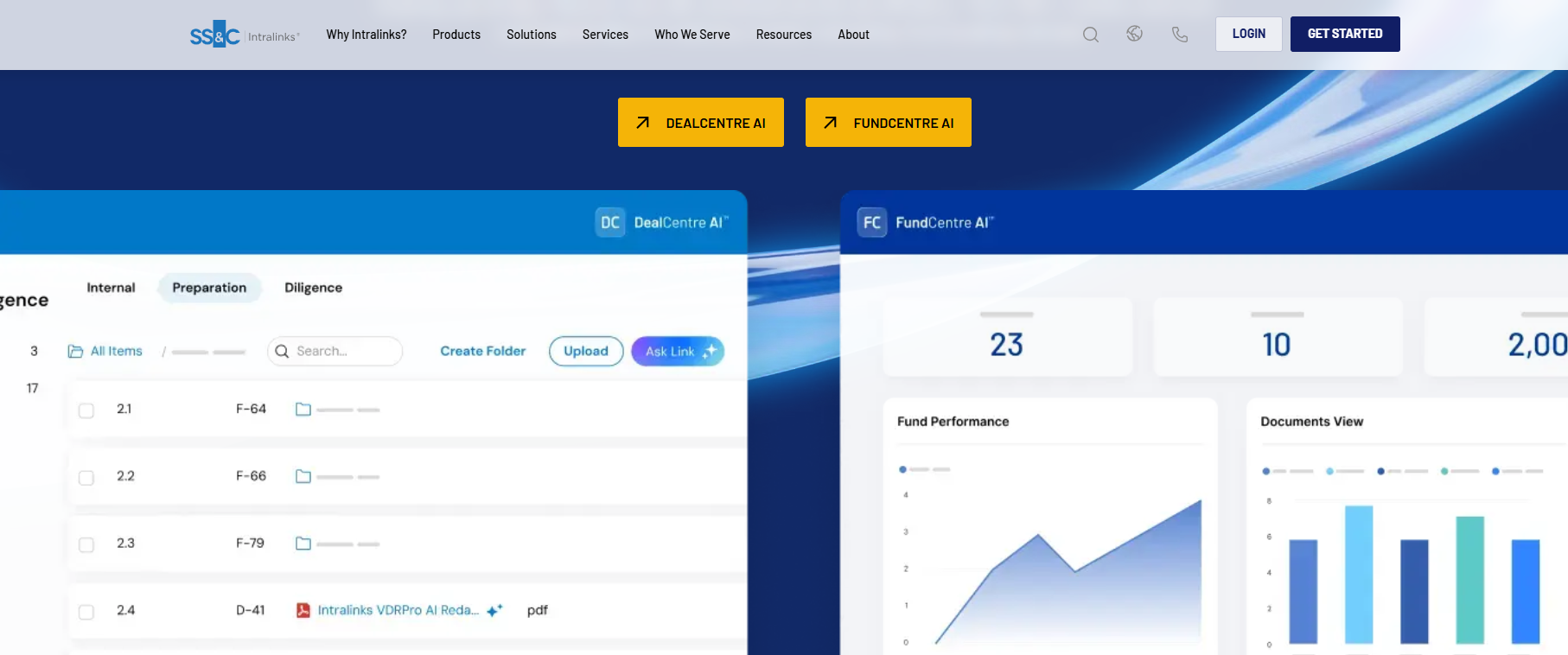
Intralinks was founded in 1996 and is widely credited with launching the first virtual data room in 2002, and it remains the other enterprise-scale incumbent, now owned by SS&C Technologies after a $1.5 billion acquisition in 2018. The platform reports having facilitated more than $35 trillion in financial transactions over its history, which is the kind of scale figure that actually means something in this category.
Its VDRPro product includes AI-driven redaction, structured Q&A, and live reporting, and its UNshare information rights management technology can revoke document access even after a file has already been downloaded, a genuinely useful control for tax workpapers that shouldn't outlive the deal. Some longtime users note the interface feels dated next to newer entrants, which is a fair tradeoff for the platform's track record with bulge-bracket banks.
Key Features
- AI-driven redaction and structured Q&A workflows
- UNshare IRM technology that can revoke access post-download
- Live reporting on document activity and bidder engagement
- Track record with $35 trillion-plus in facilitated transactions
Best For
Bulge-bracket banks and large cross-border deals where document control after the fact matters as much as document exchange during the process.
3. Ansarada

Ansarada is now a Datasite subsidiary, acquired in 2024 for roughly AUD 236.3 million, with the deal's ESG and governance products carved out separately to Ansarada's founder. What survives under the Datasite umbrella is the AI-forward deal-prep layer: AI-Sort auto-indexes uploaded documents, AI-Redact flags sensitive content, and AI-Predict scores bidder engagement to flag where a process is stalling.
The feature most relevant to tax due diligence specifically is Deal Workflow, which supports customizable due diligence checklists, Gantt-chart-style tracking, and structured NDA and RFI management. For a tax team trying to keep a due diligence checklist and a live request list in sync across dozens of open items, that structure earns its keep. Ansarada reports over $1 trillion in deals transacted and customers across 170-plus countries.
Key Features
- AI-Sort auto-indexing and AI-Redact for sensitive content
- AI-Predict bidder engagement scoring
- Deal Workflow with customizable due diligence checklists and RFI tracking
- Now integrated with Datasite's broader platform
Best For
Deal teams that want a structured due diligence checklist and request-list workflow built directly into the data room, not managed separately in a spreadsheet.
4. iDeals
iDeals is the platform most often recommended for teams that want enterprise-grade security without the learning curve that sometimes comes with it. Eight configurable permission levels, dynamic watermarking, and integrated e-signature cover the basics, and the platform added EthosData's client base through a 2024 acquisition.
Its automated Q&A and built-in due diligence checklist templates make it a reasonable fit for mid-market deals that still need real document rigor, just without Datasite's price tag or Intralinks' learning curve.
Key Features
- Eight-level granular permissions with dynamic watermarking
- Integrated e-signature and automated Q&A workflows
- Built-in due diligence checklist templates
- Fast onboarding relative to enterprise competitors
Best For
Mid-market deal teams that want strong document security without a steep setup curve.
5. Firmex
Firmex, now part of the Datasite family, remains the workhorse for lower-mid-market M&A. Its flat-rate, per-project pricing, reportedly starting around $500 a month with no per-user fees, is a real differentiator against platforms that charge by seat or by data volume, and it still ships native redaction, granular permissions, and structured Q&A.
For advisors running smaller deals where a Datasite-level budget doesn't make sense, Firmex is frequently the default choice precisely because the pricing model doesn't punish a growing user list.
Key Features
- Flat-rate per-project pricing with no per-user fees
- Native redaction and granular document permissions
- Structured Q&A and full audit logs
- Now under the Datasite corporate umbrella
Best For
Lower-mid-market advisors who want predictable pricing regardless of how many people need access.
Tax research platforms: answering the legal questions the data room raises
A data room tells you what documents exist. It doesn't tell you whether the seller's NOL carryforward actually survives the ownership change, or what the target's exposure looks like in a state where it never registered to collect sales tax. That's a different job, and it needs a different tool.
1. Bloomberg Tax
Bloomberg Tax remains the reference library for complex transactional tax work, and its Tax Management Portfolios are the reason. Portfolio 780 specifically, covering Sections 381 through 384 and Section 269, is the standing authority practitioners reach for on NOL and tax attribute questions in M&A, written and maintained by practicing specialists rather than generated on the fly.
The platform's newer AI assistant layers conversational research on top of that portfolio library, which helps with speed but doesn't replace the underlying depth. For cross-border M&A and transfer pricing questions specifically, Bloomberg's international coverage is a genuine strength.
Key Features
- Tax Management Portfolios written by specialist practitioners, including Portfolio 780 on NOLs and tax attributes
- AI assistant layered over the primary-authority library
- Strong cross-border and transfer pricing coverage
- State comparison tools for multi-jurisdiction questions
Best For
Deal teams and tax attorneys who want expert-written portfolio analysis behind a Section 382 or transfer pricing position, not just a citation.
2. Thomson Reuters CoCounsel Tax
CoCounsel Tax runs on top of Checkpoint, Thomson Reuters' long-standing research library, and launched as a named product on August 5, 2025, following an earlier July 2024 rollout of AI-assisted research inside Checkpoint Edge. It's built with retrieval-augmented generation grounded in content maintained by more than 135 in-house editors and 500-plus subject-matter experts, which is a meaningfully different trust model than a general-purpose AI tool trained on the open internet.
What separates it from a pure research assistant is that it completes multi-step tasks: drafting a due diligence memo, comparing documents inside its Workspaces feature, or running a standardized analysis template across a document set. Thomson Reuters states it does not train on user data, a detail worth confirming before uploading a target's confidential tax files, and it integrates directly with Excel, SharePoint, and OneDrive.
Key Features
- Grounded in Checkpoint content maintained by 135+ editors and 500+ subject-matter experts
- Multi-document Workspaces for comparison and memo drafting
- Standardized analysis templates for repeatable due diligence tasks
- Direct integration with Excel, SharePoint, and OneDrive
Best For
Firms already on the Thomson Reuters stack who want AI-assisted drafting layered on top of an authority library they already trust.
3. CCH AnswerConnect

CCH AnswerConnect is Wolters Kluwer's research platform, and its main selling point against the two options above is price. The underlying research library is strong, particularly for federal compliance questions, and the platform has added its own AI search capability without pushing into CoCounsel Tax or Bloomberg's price tier.
For a tax team that needs solid primary-authority coverage on standard M&A questions without paying for the deepest transactional portfolio library, this is often the pragmatic middle option.
Key Features
- Strong federal tax research library at a lower price point than competitors
- AI-assisted search across the CCH content library
- Familiar interface for firms already using Wolters Kluwer products
- Broad coverage of standard compliance and entity-level questions
Best For
Cost-conscious tax teams that need reliable federal research without the premium pricing of a full transactional-tax portfolio library.
4. Blue J
Blue J takes a different approach to the same problem: instead of just returning a citation, it compares a fact pattern against how courts have actually decided similar cases and produces a predicted outcome with the reasoning attached. For a due diligence question where the position is genuinely contestable, seeing how comparable fact patterns resolved historically is a different kind of signal than a plain citation.
The platform is distributed in partnership with Tax Notes and via CPA.com, and the company states it's trusted by more than 5,000 firms, with more than 8 million tax questions answered on the platform to date. Blue J's own homepage reports users save around 3 hours per week; a separate OpenAI case study on the platform put the figure at 2.7 hours per user per week, with more than 70% of users logging in weekly. Either way, that's a meaningful adoption signal for a tool built specifically around gray-area federal positions.
Key Features
- Predictive outcome modeling based on how courts have decided comparable fact patterns
- Distributed via Tax Notes and CPA.com partnerships
- Citation-backed research with judicial reasoning comparison
- Reported 2.7 to 3 hours saved per user per week, depending on the source
Best For
Tax teams evaluating audit risk on a specific due diligence position, where precedent and predicted outcome matter as much as the bare rule.
5. Bizora AI
Bizora AI is the research platform most directly built for deal and M&A tax work rather than general compliance. Founded by a CPA and former EY international tax manager, it pulls exclusively from primary authority, the IRC, Treasury Regulations, IRS rulings, and case law, and covers all 50 states for SALT questions like nexus and apportionment, plus GILTI, FDII, Subpart F, Section 245A, and treaty coverage for cross-border deals.
What matters most for due diligence work specifically is the View Steps feature, which exposes the full reasoning path behind an answer so a practitioner can verify it against the underlying sources rather than take it on faith. Vault gives a team a secure workspace to upload and query deal documents directly, and Canvas turns a research answer into a due diligence memo without switching tools, the same workflow covered in our guide to extracting client data and drafting research memos. The platform is explicit that it amplifies professional judgment rather than replacing it, which is the right posture for work this consequential.
Key Features
- 50-state SALT coverage plus GILTI, FDII, Subpart F, Section 245A, and treaty analysis
- View Steps: a full, auditable reasoning trail behind every answer
- Vault for querying uploaded deal documents directly
- Canvas for turning research into a finished due diligence memo
Best For
Deal tax teams and solo practitioners who need citation-backed answers on Section 382, entity election, or SALT nexus questions, with a reasoning trail they can put in front of a partner or an examiner.
AI contract review tools: reading the data room faster
These tools scan the document population itself, extracting clauses across hundreds or thousands of files far faster than a human reviewer. They are genuinely powerful for legal due diligence. None of them performs tax analysis.
1. Kira (Litera)
.png)
Kira is the mature standard for AI contract review in M&A, acquired by Litera in August 2021 for an undisclosed amount. Its library of more than 1,400 lawyer-trained models extracts change-of-control provisions, assignment clauses, and similar terms across data rooms running from 500 to 5,000 contracts, with strong reported extraction accuracy.
Enterprise pricing is quote-based and sits at the premium end, which puts it squarely in AmLaw 100 and Big Four territory rather than solo-practitioner reach. For legal due diligence specifically, that maturity and training depth is exactly what large deal teams are paying for.
Key Features
- 1,400+ lawyer-trained models covering common M&A clause types
- Prebuilt coverage of change-of-control, assignment, and similar provisions
- Strong reported extraction accuracy across large contract populations
- Deep adoption among AmLaw 100 firms and Big Four advisory practices
Best For
Large legal teams running contract review across thousands of documents who need a mature, extensively trained extraction engine.
2. Luminance
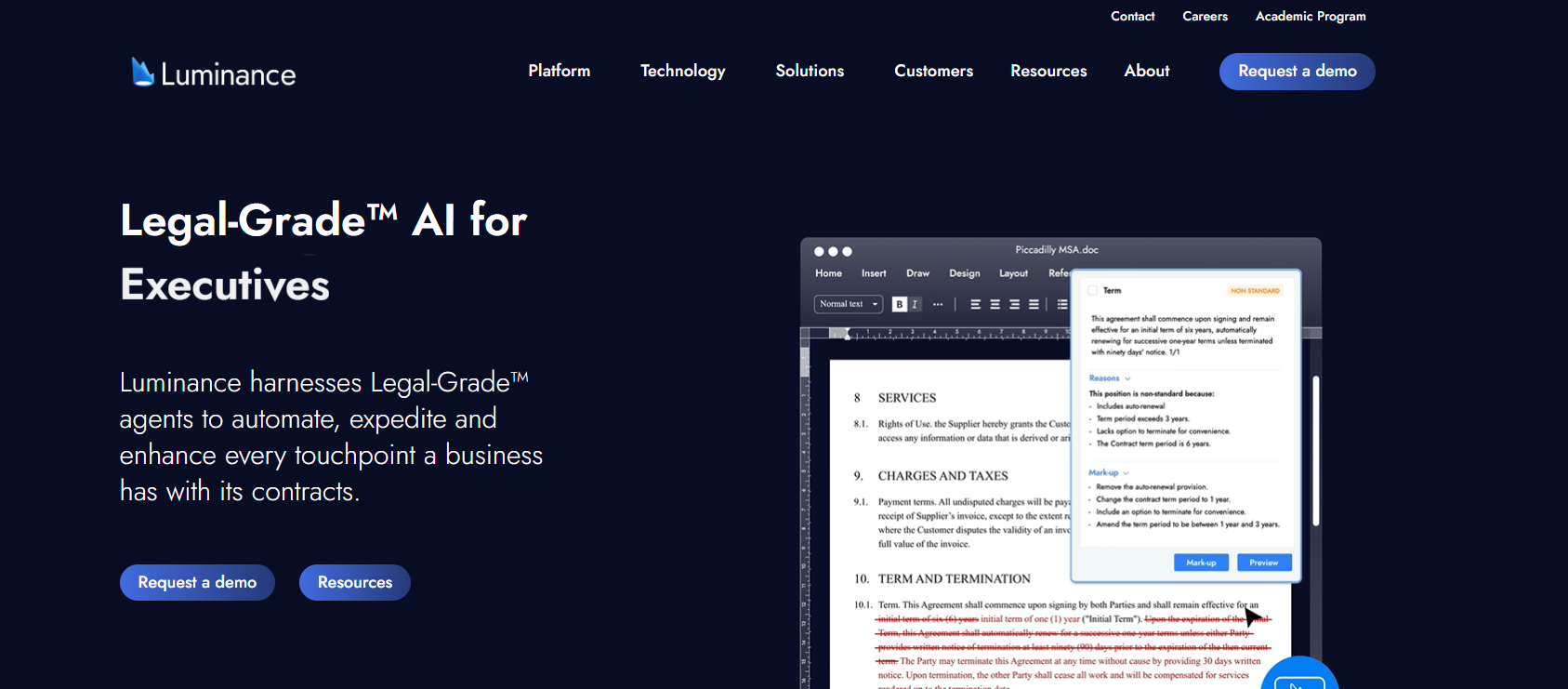
Luminance takes a "panel of judges" approach, running multiple AI models against a document and reconciling their outputs rather than relying on a single pass. The Cambridge-founded company closed a $75 million Series C in February 2025 led by Point72 Private Investments, bringing total funding to roughly $165 million, and reports more than 700 customers across 70-plus countries.
Its auto-classification on upload and cross-document anomaly flagging are useful for spotting outlier terms across a large contract population, and its support for 80-plus languages is a real advantage on cross-border deals where the data room isn't uniformly in English.
Key Features
- "Panel of judges" multi-model approach to document review
- Auto-classification and anomaly flagging across document sets
- Support for 80+ languages
- 700+ customers across 70+ countries
Best For
Cross-border deal teams reviewing multilingual document populations who want automated anomaly detection, not just clause extraction.
3. Hebbia

Hebbia built its reputation in financial services before expanding into legal and diligence use cases, and its "Matrix" grid interface, which lets a user run the same question across hundreds of documents at once, is the closest thing on this list to a financial due diligence tool rather than a purely legal one. The company raised $130 million in a Series B at roughly a $700 million valuation in July 2024, on reported annual revenue of about $13 million at the time.
The company reports the product is used by roughly 30% of the top 50 asset managers by AUM, and reported clients include Centerview Partners and Charlesbank. That financial-services pedigree is exactly why it shows up on M&A deal teams' shortlists even though it wasn't built as a legal-specific tool.
Key Features
- Matrix interface for running one question across hundreds of documents simultaneously
- Strong existing adoption in financial services and asset management
- Reported clients including Centerview Partners and Charlesbank
- Faster iteration on financial and operational due diligence questions than clause-specific tools
Best For
Deal teams doing financial and operational due diligence who want to query a large document set the way an analyst would, not just extract legal clauses.
4. Harvey

Harvey is the elite legal AI platform of the moment, closing a $300 million Series E at a $5 billion valuation in June 2025. It's built for BigLaw and elite private equity legal work, handling contract Q&A and representations-and-warranties extraction at a level of polish that reflects its funding and client base.
For deal teams already inside a Harvey-equipped law firm's workflow, it's a capable extension of the legal review process. It carries the same limitation as every other tool in this category: it reads contracts, not tax exposure.
Key Features
- Contract Q&A and representations-and-warranties extraction
- Built for BigLaw and elite private equity legal workflows
- Well-funded platform with rapid feature development
- Deep integration into existing law firm document review processes
Best For
Deal teams working alongside law firms already standardized on Harvey for legal document review.
How we evaluated these tools
Every tool on this list earned its place against four questions specific to what M&A tax due diligence actually requires:
- Primary job: Does the tool secure and organize documents, answer legal tax questions, or extract contract terms? These are different jobs, and a platform built for one doesn't substitute for another, no matter how the marketing reads.
- Authority grounding: For the tax research tools specifically, does the output trace back to the IRC, Treasury Regulations, rulings, or case law a practitioner can verify, or does it rest on a proprietary model with no visible citation trail?
- Adoption and track record: Is the tool actually used at the scale and in the deal segment it claims, backed by a real funding history, customer count, or transaction volume, not just a marketing claim?
- Honest limitation: What does the tool not do? A VDR doesn't research tax law. A contract review tool doesn't compute a Section 382 limitation. Naming the boundary honestly is what makes the recommendation useful.
We did not rank tools by how much they spend on marketing. We assessed what each one actually does for a due diligence file that has to survive a partner's review, or an IRS examiner's.
The tax concepts that decide whether a due diligence finding actually matters
A data room full of documents and a fast AI tool for reading them are only useful if the team reviewing the output knows which findings are load-bearing. These five are where tax due diligence in mergers and acquisitions most often turns up real exposure or real value.
1. Section 382 and the survival of NOLs
An ownership change, generally a shift of more than 50 percentage points among 5%-or-greater shareholders over a rolling three-year period, triggers an annual limitation on how much of a target's pre-change NOLs and credits can offset future income. The limitation is roughly the pre-change equity value multiplied by the long-term tax-exempt rate.
This is not a theoretical risk: Celldex Therapeutics disclosed in its FY2025 SEC filing that roughly $758.7 million of federal NOLs and $48.7 million of federal credits would expire unused specifically because of Section 382 and 383 limitations, a real illustration of how much attribute value a deal structure can destroy if nobody checks.
The same attribute review often turns up R&D credits the target never claimed, worth cross-checking against our breakdown of the tools built for that specific research.
2. Sections 338(h)(10) and 336(e): the asset-versus-stock decision
Both provisions let a stock purchase be treated as an asset purchase for tax purposes, giving the buyer a stepped-up basis in the target's assets. Section 338(h)(10) requires a joint buyer-seller election and is common for S corporations and consolidated subsidiaries; Section 336(e) can be made unilaterally by the seller and reaches some situations 338(h)(10) doesn't cover.
Getting this election analysis wrong, or missing the deadline to make it, can swing deal economics meaningfully for a target with significant intangible value. Where the buyer and seller are commonly controlled or the deal creates ongoing intercompany arrangements, also check whether Section 267's related party rules affect the timing of any resulting deductions.
3. Section 197 and 15-year intangible amortization
In a transaction treated as an asset purchase, acquired intangibles, goodwill, customer lists, trademarks, and covenants not to compete, amortize straight-line over 15 years. In a pure stock deal with no election, the seller's basis carries over with no step-up at all. For an intangible-heavy target, that difference is a major driver of whether the buyer pushes for asset treatment in the first place.
4. SALT nexus exposure since Wayfair
Since South Dakota v. Wayfair in 2018, economic nexus, commonly triggered by $100,000 in in-state sales with no physical presence required, can create a sales tax collection obligation the target never registered for.
Because unremitted sales tax attaches to the business and its assets, a buyer can inherit successor liability for years of unfiled returns, and many states have no statute of limitations on a return that was never filed at all.
This is consistently cited as the single largest source of surprise tax exposure in M&A due diligence, and remedies typically involve a price adjustment, an indemnity, an escrow, or a voluntary disclosure agreement before closing.
5. OBBBA's effect on deal structuring
The One Big Beautiful Bill Act, signed July 4, 2025, made immediate expensing of domestic research costs permanent, restored 100% bonus depreciation, and shifted the Section 163(j) interest limitation calculation back to an EBITDA basis starting in the 2025 tax year.
Every one of those changes affects how a target's post-close tax position actually looks, which means due diligence work done on pre-OBBBA assumptions needs a second look before it's relied on.
Matching the right tool to your deal
Start with the document layer, since every deal needs one. For a large, competitive, or cross-border process, Datasite or SS&C Intralinks is the default; for a mid-market or lower-mid-market deal, iDeals or Firmex covers the same ground at a lower price point.
Layer in a tax research tool next, and pick based on what the deal actually demands. Bloomberg Tax's portfolio depth suits complex cross-border and transfer pricing questions. Thomson Reuters CoCounsel Tax fits firms already standardized on Checkpoint.
Blue J earns its keep when a position is close enough to argue either way and precedent matters. Bizora AI is built specifically for the deal-team use case: fast, citation-backed answers on Section 382, entity elections, and multi-state SALT exposure, with a reasoning trail a partner can actually check.
Add an AI contract review tool only if the document volume justifies it. Kira and Luminance suit large legal teams running structured clause extraction across thousands of contracts; Hebbia fits financial and operational diligence questions specifically. None of them replaces the tax research layer, and treating one as if it does is exactly the gap that turns into a missed Section 382 finding six months after closing.
Bizora AI sits in the research layer specifically for deal teams, answering Section 382, entity election, and SALT nexus questions with citations traced to primary authority and a reasoning trail built for partner review. Research a due diligence position with Bizora AI and see the citation trail behind the answer before the next request list item comes due.
Frequently Asked Questions
What software do M&A deal teams use for tax due diligence?
Deal teams typically run three tools together: a virtual data room (Datasite, SS&C Intralinks, iDeals, or Firmex) to hold and exchange documents, a tax research platform (Bloomberg Tax, Thomson Reuters CoCounsel Tax, or Bizora AI) to answer the legal questions, and often an AI contract review tool (Kira, Luminance, Hebbia) to scan large document populations faster.
Do virtual data rooms perform tax analysis?
No. VDRs like Datasite and Intralinks secure, organize, and track documents through Q&A workflows, but none of them analyzes tax positions. Answering whether a Section 382 limitation applies or whether SALT nexus exposure exists still requires a dedicated tax research tool or a specialist.
Is there an AI tool built specifically for M&A tax due diligence?
Not among the major contract review platforms. Kira, Luminance, Hebbia, and Harvey extract clauses like change-of-control and assignment provisions, not tax exposure. Bizora AI is the closest fit for the tax-specific research layer, built to answer Section 382, entity election, and SALT questions with citations rather than to scan contracts for clauses.
What is the biggest tax exposure typically found in M&A due diligence?
Unremitted sales tax from economic nexus is consistently cited as the largest source of surprise exposure. Since South Dakota v. Wayfair, a target can owe sales tax in states where it never registered, and because many states have no statute of limitations on an unfiled return, that liability can attach to the buyer at closing.
How much does a virtual data room for M&A cost?
Pricing varies widely by tier and is largely opaque. Enterprise platforms like Datasite are quote-based, with buyer-reported estimates clustering around $68,000 a year and full annual spend commonly running $50,000 to $200,000 depending on deal volume; mid-market and lower-mid-market platforms like Firmex use flat-rate per-project pricing reportedly starting around $500 a month with no per-user fees.